
Monday, May 9, 2011
This is fundamental. It changes everything.
I recently discovered the ideas of Vittorio Guidano, who from what I can gather was a Chilean psychologist who wrote on an approach to cognitive therapy he called "post-rationalism" (there is very little information about him or his writings in English; I have found one decently translated interview and one essay, both intended to provide an easy-to-understand summary of post-rationalism). He is someone I wish I knew about 4 months ago; the concepts of post-rationalism are really relevant to what I wanted to explore both in my thesis and in general. It maintains that logical, rational thought is only a portion of the ways humans can and do interact with the world, and there are plenty of legitimate other ways to experience the world besides through rationality (for example, emotionally). The interview is great, it talks about self-contained order, the world as one perceived by non-impartial entities, and domains in which logic isn't applicable. I'm going to continue to try to find books or anything in English, though he also makes me want to speak Spanish.

Tuesday, May 3, 2011
A good solid net for me, too
I haven't blogged about a singular artist in a while, and Javier Pinon's been on my list of artists to write about too long as it is. First of all, collage is something I have wanted to work with for a really long time but never have had much luck with; a lot of good displacement going on in it. But Pinon not only fulfills my collage lust, but has a great offbeat, folky, neo-neo-classical style. He turns classic mythological tales into psychedelic westerns, or maybe the other way around, and creates great scenes of weird human-animal hybrids engaging in weird death rituals. He's one of a too-small pool of artists who make me really really want to make shit; his colors and sources and compositions are out of this world. Is Pinon's work more style than substance? Maybe. But it's still a wellspring of ideas and feel-goodness. Also, the size of these really cracks me up, but that's an inherent limitation of collage I suppose. Which I approve of.

The Sacred Grove, Javier Pinon, 2010, collage, 16"x26", from his website.

Hercules and the Hydra, Javier Pinon, 2007, collage, 11.5"x8", also from his website.

The Sacred Grove, Javier Pinon, 2010, collage, 16"x26", from his website.

Hercules and the Hydra, Javier Pinon, 2007, collage, 11.5"x8", also from his website.
Tuesday, April 12, 2011
Can do anything
 Roy Lichtenstein, and Pop artists in general, use a vocabulary which is both very culturally dependent but very universal within that frame. Bombshells (of both the exploding and blonde types), brooding dudes, primaries and flesh tones, halftone patterns, melodrama and speech bubbles are used... I don't really want to talk about him as critiquing the art world, mass entertainment and so on. Instead, I'm going to focus on my favorite element, the speech bubble and text. I imagine what the images would be without the contextualizing words; the inner turmoils and angst become externalized and smack ya. Text in artwork is a kind of funny paradox; it conveys more complex and subtle emotions but in a very direct way. Speech bubbles have a great, specific purpose, and when are put in different context do crazy things. Rivane Neuenschwander is an artist from Brazil who removed the context of a nationalistic Brazilian comic strip from the speech bubbles, leaving abstracted forms and colors. Text that is meant to be read as coming from some entity within a piece of art is a lot more interesting; there are implications of what the artist knows versus what the character knows versus what the viewer knows.

Top: "Ohhh... Alright" by Roy Lichtenstein, 1964. From a blog called the Swipe Files, which looks at similarities between elements in cartoons, comics and graphic novels through the issue of plagiarism, homage and reappropriation.
Left: "Zé Carioca no. 4, A Volta de Zé Carioca [The Return of Zé Carioca] (1960)" by Rivane Neuenschwander, 2004. From an article in This Week in New York.
Thursday, April 7, 2011
Please look above
I've been thinking about camouflage patterning, particularly the use of camouflage by humans. The defining characteristics are interesting, especially considering what appears (to me) to be common perspectives of such. One, the specific aspects of camouflage are quite different from those in other patterns. It inherently doesn't have a definable overall structure, because then what's the point, and it does typically have a definable color scheme, because that is the point. Traditional fashion patterning can be executed in any palette. What interests me most is perhaps the necessity of a particular environment for the patterning to be effective, as well as knowledge of what viewers (the audience) knows. Total awareness of the surrounding, unpredictable yet a pattern... Site specific? It's clear why it's not used in much or any ornamentation, but it also seems to have a lot of substance (and I'm also interested in removing the militaristic connotations, sort of. I was totally into military history as a kid and running around in the woods, still, so I can live with it.)
The question then becomes, what are effective and necessary means of incorporating the elements of camouflage into what I'm making? As I said, site-specific artwork is an obvious answer but doesn't interest me much. It does rely totally on the illusory and making one thing look like another. Mixed media, or something. In the meantime, and for your consideration, here's one of my favorite patterns (flecktarn, from Germany).

The question then becomes, what are effective and necessary means of incorporating the elements of camouflage into what I'm making? As I said, site-specific artwork is an obvious answer but doesn't interest me much. It does rely totally on the illusory and making one thing look like another. Mixed media, or something. In the meantime, and for your consideration, here's one of my favorite patterns (flecktarn, from Germany).
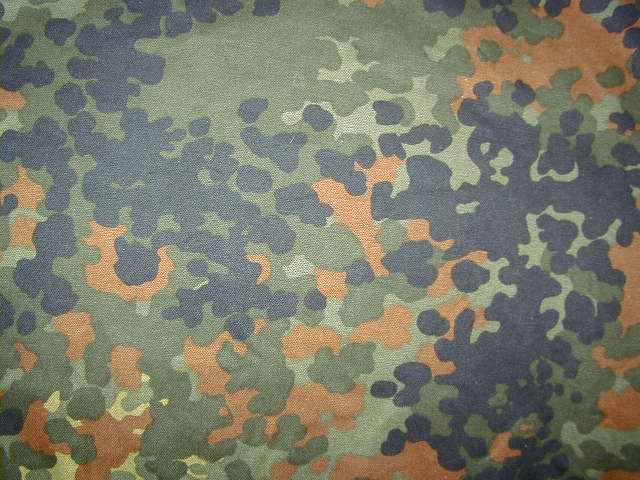
From wikipedia.
Saturday, April 2, 2011
I am separate
Before I could work through my list of ideas I thought would be useful to do so I could best communicate about my work, something came up (my show). I'm completely happy with how it went; thanks to everyone who came and to Jenn and Courtney and Liz. Today it hit me mid-shave that most of my time this semester I have devoted to last night, for better or worse (and a case could be made either way). All I know is for the rest of the semester I'm not using any more damn cream heavyweight paper. Probably pencil work drawn from real-life referents. Maybe some more painting, I wonder how much I can apply what I learned over the past several months back into painting, which I feel pretty incompetent with still.
Sunday, March 13, 2011
It's an idiom for a reason, but I'm not going to say it.
A point that I've found myself returning to many times so this can be short and sweet I hope. My drawings are of entireties, an entire field, flock, or texture. There isn't anything beyond the page, so I don't want to imply that there is, this is a given. Michael Frank referred to me illustrating the 'whole' as a power play, which I found amusing and true. All this is mirrored in how I want them to be viewed as a singular composition first, then perhaps the individual elements inspected. The individual elements, by the way, also have to fit within the part/whole issue. They themselves are made of sub-particles, and are sub-particles themselves within the drawing - it's all very recursive. Anything else I say is probably a retread of my previous posts, a good sign: life (or art) imitating art (or life)?
Wednesday, March 9, 2011
Off in the distance
I don't want to be defensive, though this post is and probably should not be. My drawings certainly are repetitive, and I understand how they one might interpret them as 'obsessive,' but I don't look at them as either. I do not find them repetitive in execution: each iteration on the page is distinct from the ones prior, an act of active forgetting, each an attempt to match the ideal which I have constructed in my head. The process of placing the first drawing on the paper is no different than placing the last.
These are all also the basis for why my drawings are not obsessive - I let go of what I have done previously with ease, I don't let past errors influence my current task. Making more drawings does not add more meaning (meaning is necessitated by a full page taken as a unit). Obsession is rooted in the past, these drawings require the present. My current plan of display will hopefully allow them to be viewed primarily on a holistic scale. Viewing will not jump from one object in a drawing to another to another to another in the repetitive spirit and will shift instead to the drawings as a whole, a creation which is very much not repetitive (see post about patterns).
These are all also the basis for why my drawings are not obsessive - I let go of what I have done previously with ease, I don't let past errors influence my current task. Making more drawings does not add more meaning (meaning is necessitated by a full page taken as a unit). Obsession is rooted in the past, these drawings require the present. My current plan of display will hopefully allow them to be viewed primarily on a holistic scale. Viewing will not jump from one object in a drawing to another to another to another in the repetitive spirit and will shift instead to the drawings as a whole, a creation which is very much not repetitive (see post about patterns).
Tuesday, March 1, 2011
Tile versus stucco
I'm not interested in patterns (from a design perspective), I'm interested in pattern identification (from an observational perspective) and I think there's a huge difference. Patterns are conscious repetitions with a definable formula for their creation. The only true pattern in my drawings are the individual marks which I then repeat to make a composition. Patterns found on the larger scale - spatial, textural and structural specifically - are prescribed by the viewer; the placement of patterns (objects) into the scope of the whole drawing is automatic, dictated by what is near and where I think I 'need' to work next. The larger compositions appear to have elements of pattern but disseminate into randomness quickly; there does not exist a formula to define them but it can be found. The objective natural world doesn't consider things in succession, only one element and then another element and it's up to us, the subjective observer, to condense this into a comprehensive, defined pattern.
That felt good.
That felt good.
Monday, February 28, 2011
Lastly there is a fork.
The past several weeks I've been thinking about my drawings in a way which is I found to be a dead end, but I'm glad that it happened - it's not often I reach a satisfying conclusion in my work (a satisfying dead end?). I was introduced to the concepts of structuralism and semiotics, which I will let wikipedia summarize, but I fluctuate back and forth often as to how focal these concepts should be to my work. The most obvious connections are in how my work is reliant upon bringing in information that isn't objectively available (an understanding of something on an arbitrary level) and how I use a fixed set of actions to create an object. It's actually fairly easy to discuss my work in these terms. However these terms don't strike me as particularly functional, except perhaps to provide some legitimacy through linguistic theory. It's easier to discuss my work in other terms that are less alienating, especially because it's not all that close to being my sole focus. If someone views my work in this manner, I would be comfortable with discussing this and knowing that it is not off base at all. But I also want to keep it from being the sole hangup that people respond to when they view my work.
Saturday, February 26, 2011
It's called that for a reason you know.
First on the list is the idea of one's (my) place in the world that is not the self (me). One of the first concepts I wanted to address in the series, I wanted the process of drawing - placement and concentration - to be a reaction to my immediate state and in doing so, each individual object reflects its relationship to those closest to it. The goal is to eliminate any detachment I have from the drawings, a state which I find difficult to achieve but is ultimately rewarding.
I'm no longer as focused making my drawings process-central as is necessary for this reading but it still informs my act of drawing - sitting and repeating the form is a sort of meditative state which I think does translate into my pieces, and awareness of what I am doing becomes key and a fulfilling act in of itself (I'm not drawing split pieces of wood just to end up with a bunch of split pieces of wood). But this is a back burner sort of idea that is important for production but not in explanation. This I can let go for now.
I'm no longer as focused making my drawings process-central as is necessary for this reading but it still informs my act of drawing - sitting and repeating the form is a sort of meditative state which I think does translate into my pieces, and awareness of what I am doing becomes key and a fulfilling act in of itself (I'm not drawing split pieces of wood just to end up with a bunch of split pieces of wood). But this is a back burner sort of idea that is important for production but not in explanation. This I can let go for now.
Thursday, February 24, 2011
In which Jeremy pares down
This past week a respectable source firmly suggested that I articulate and solidify the concepts in my drawings. I get as far as some tasty ways of phrasing what I'm thinking about but get stuck a few sentences in. It's time to quiet my thoughts, decide which I'm comfortable letting go of. Lists might be helpful.
Awareness of the self and surroundings
Symbols and what they represent / how they relate
Recognizing and organizing patterns
Why I'm resistant to 'repetition' and 'obsessiveness'
The summation of parts into a whole... and beyond
Comfort
Ambiguous forms
How and if 'human' processes all of this differently than 'nature'
All these and maybe more to be sifted through and potentially discarded. The roundabout path in which I currently have to take to reach my point does not sit well with me currently. I'm making drawings of earthworms, sproutlings, split logs and radiators for goodness' sake.
Saturday, February 19, 2011
In which Jeremy gets down
I think I made a post once and claimed many times that restricting myself in some ways forces creativity in others. Sometimes I impose this upon myself ('if I can say what I want, I can say it in these frames which I already built'), sometimes they happen to me out of necessity. After visiting the room in which I'm displaying yesterday I had to begin to consider how to display as much as I want in not a very large area. And I think this is good for me because it's making me rearrange things in positive and meaningful ways (as opposed to a sharp-looking row of drawings. Vertical pairings - one airy field of tiny objects above one solid field of tick marks. Feeling good until it needs to be revised, which it will not.
Monday, December 13, 2010
THIS is how you climb a mountain!
Why are symbiotic forces so often at odds? For a while I believed I had to sacrifice making images of things I want in order to fully appreciate the act of creation and the sensation of drawing. Then I thought of the Spanish Romantic Francisco Goya, one of the first artists whom I deeply admired. I was naturally stricken by his painting of a crazed Saturn devouring his headless bloody offspring and the other paintings he created during his downward spiral. And while subject matter is important and fascinating, it’s also clear that Goya had an intimate relationship with the physical paint as well, which is essentially a given at this point in the orbit of whatever heavenly body would best complete the metaphor of visual arts. During the late 18th and into the early 19th centuries, however, this was not the norm, so Goya’s series the Black Paintings were even more disturbing.
As a side note which I find necessary at this point - the ideas I’m expressing in this post are also completely relevant to the work of Michelangelo Merisi da Caravaggio. I spent a lot of time thinking about which of the two I would like to discuss and Goya won due to his seniority in my personal chronology (also thought about writing about them in stereo, but didn't want to anger the art history bitches). The Incredulity of Saint Thomas is one of my absolute favorite paintings for all the reasons here mentioned and those after, and I appreciate how he was much more subtly subversive than that freak Goya. I’m a bit sick of using typically negative descriptors as merits. But I am also much more informed of Goya’s work than that of Caravaggio, so here we are. Side note done.

The Incredulity of Saint Thomas, c. 1601-1602. Thanks, wikipedia.
I think regardless of the subject matter, to devote so much time and energy to painting and thinking about how things are and what they might be shows just as much love of the medium as Hans Hoffman or any of his colleagues. If there’s a moral to this story, it’s that sacrifice shouldn’t be a concern. If I wish to make dragons (why haven’t I done this yet?), but I also want to just draw, that’s not a contradiction unless I make it one. Which I won’t.


Self Portrait in the Studio, 1790-1795. Thanks again, wikipedia.
Wednesday, November 24, 2010
It's about time, about time.
I hate the idea of living in the past. There must be ideas and people existing and working today that mean something today, and there are, but that’s a lot of looking. Until then there are previously established artists that have done what I am looking for and look to. It’s less of a competition that way. While I was a fetus and prior, there were some (many, actually) musicians working under principles very similar to the Hofmann quote on simplicity and necessity I presented a while ago. The Minutemen declared it “jamming econo,” Fugazi didn’t have a name for it but acted under its principles. They weren’t interested in being loud for loudness’ sake, although they often were, and their lyrics approached preachy and heavy handed often, but because that’s what they wanted to say. Concerts and albums were cheap, as was merchandise (if they had any at all), slept on floors, working in a method that disposed the idea of privilege and cutting excess in all forms. Despite this neither of these bands (I focus on the Minutemen and Fuazi only because they are the most prominent in applying these principles) were traditionalists, and actually quite the opposite. Restriction on some fronts yields creativity and experimentation on others.
Upon further reflection on my unease with the gap of twenty or more years between the bands and me, their principles are no less valid now than they were in the 1980s and 1990s. There is a difference between rehashing what has been done and adopting what finds admirable about what has been done. The latter is honest and in itself admirable; a difficult trial for me is to recognize that many ideas I work with have been dealt with before but nothing has changed so much that they now have no weight.
"Shut the Door" by Fugazi, from their 1999 documentary Instrument (recorded sometime between 1988 and 1993)
"Ack Ack Ack" by the Minutemen, music video, 1985.
Tuesday, November 23, 2010
Ripped from a piece of pie
A distinct line divides the work of Monique Prieto. Prior to 2003 she produced great form and color studies, abstracted silhouettes but obviously something. After a two year hiatus her work now tends toward the text-based, lifted from the diary of Samuel Pepys (the true beginning of self-indulgent obsessive performance art?), and equally abstract yet relatable. She pulls a classic abstract artist move and refrains from commenting on the interpretations of her art, as her vague allusions lend themselves to. Prieto works in a lot of areas that I also try to focus on – the ability of color and form to stand alone, opaque meanings, stylized strings of text out of context. I’m unsurprisingly more drawn to her abstract pieces, but as I think more and more about how and if I should be using text in my art, Prieto’s catchy sayings (such as “BELLS RANG EVERYWHERE” or “WALKING BOTH FORWARDS AND BACKWARDS”) rendered in non-uniform sizes and partial legibility are important for me to keep in mind. She is an artist that I can both look to for what I am doing and focusing on now, as well as directions I may want to head.

On the Other Side, 1997. Found on the blog of some MFA student in Ontario.

Last Night's Dream, 2007. From the ACME gallery's website, where a show of her work was recently held.

Opus, 2002. From an essay on artlies.org called "Dumb Art: The End of Representation." I'd recommend reading it, a recap of the debate between conceptual artists and painters. Guess which side I align with.
Sunday, November 21, 2010
Stand on a road and get hit by a car
Everything is compared to anything else. Tenuous connections are the mark of genius. How can so-and-so relate to such-and-such? A semi-plausible relationship is lauded. The combination of disparate factors in this way is interesting for only so long; I’d much rather see an acknowledgment that this is not reality (and focus on the nature of one concept, than one and another), but I do not control what others make, so this is often what I see. AJ Fosik is not so different in this aspect than many artists who rely so heavily on juxtaposition. Except he makes wooden sculptures of FUCKING MYSTICAL BEARS IN FLUORESCENT COLORS. Fangs, limbs, weapons, colors recalling those of figures from Hindu, Native American, Chinese, psychedelic, cartoon, and 80s differentiae, Fosik approaches these as elements of his goal instead of comparisons for their own sake (his goal remains elusive to me – some allusions to the “American identity,” and some words that don’t really mean much on their own). If not for the imagery and sheer volume of Fosik’s work, I doubt I would have any interest, but there’s something about a big wooden bear beheading another with a hammer that I can’t hate. Between this and his production levels, and technical crafting abilities, I admire and am inspired by Fosik without any strong feelings about the concepts behind his creations. Also, he knits sweaters of beer label designs.

The Third Way Out, 2009. Wood, paint, nails. From AJ Fosik's Flickr stream.
Subscribe to:
Posts (Atom)